
Getting Clay County Court Records
Start with three things. Know the court, the case number, and the paper you need. Circuit and family material sits with Clarissa Hanshaw, Clerk of the Circuit Court. Magistrate files go to Trisha L. Triplett, the Magistrate Court Clerk. Deeds, probate, election records, and county commission papers belong to the elected County Clerk instead. That office does not hold circuit or magistrate court records for Clay County. Route your request accordingly.
Online options are split by court level. WVPASS offers public circuit case search. It also has public document images going back to 1999. MCRS gives free magistrate case information and a document list, though not the documents themselves. Phone the right clerk with your questions. Ask about mail requests, accepted payment, ID, postage, or certification wording. Clay County publishes no special copy-request form. There is no email route, no fixed turnaround time, and no certification surcharge.
- Find the court and save the exact case number, party name, case type, and county.
- Use WVPASS for circuit records or MCRS for magistrate case information. A missing result calls for clerk contact.
- Call, mail, or visit the right clerk. Name the document, its filing or order date, and the party role.
- State whether a plain copy, certified copy, inspection appointment, or electronic public document will meet the need.
- Confirm the fee, payment method, postage, identification rule, and delivery method before sending funds.
Three Clay County Record Layers
Three layers, three products. The docket is the running index of filings, hearings, and outcomes. The filed document is the complaint, motion, order, judgment, exhibit, or notice behind any given entry. A certified copy is something else again. The clerk who keeps the original issues it and authenticates it. Printing a page from an online search does not turn it into a certified copy of the record.
| Layer | Clay County Access | What It Proves |
|---|---|---|
| Docket or case events | WVPASS, MCRS, or the proper clerk | The indexed sequence and public case status |
| Filed document | WVPASS where available, or a clerk copy request | The text of a filing, notice, order, or judgment |
| Certified copy | Issued by the Circuit or Magistrate Court Clerk | A clerk-authenticated copy for formal use |
The West Virginia court-record access page lays out the split between the circuit and magistrate search routes. Its structure shows why a Clay County court record search has to begin with the court level, since each path leads to a different system.
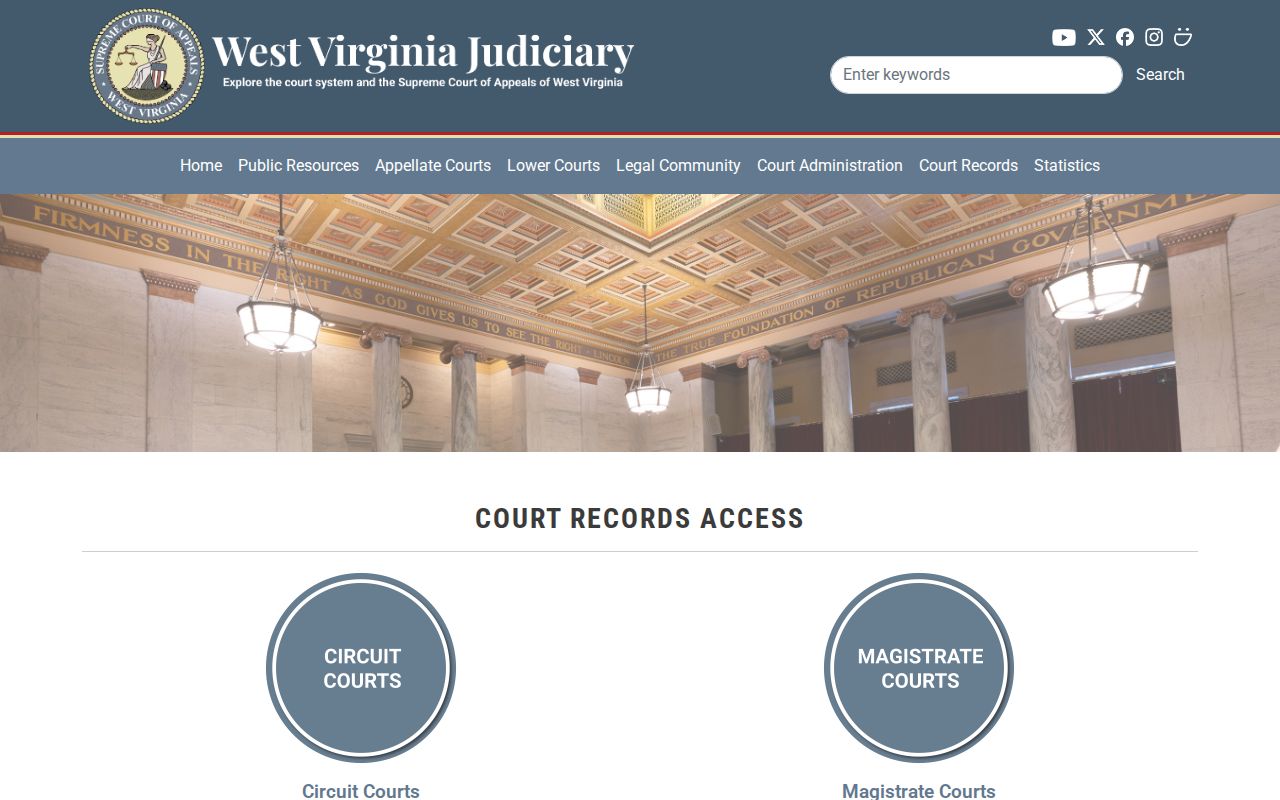
The state page sends searchers down two separate roads. Validation still runs through the Clay County clerk who owns the file.
Note: An online docket helps identify a record, while only the custodian can issue a certified Clay County court record.
Court Record Types
Each Clay County court leaves its own paper trail. Circuit records can include civil complaints, felony matters, motions, judgments, and cases transmitted on appeal. The Circuit Clerk also keeps family court material. Public access splits sharply there between public orders and indices on one side and confidential file contents on the other. Magistrate files cover misdemeanors, traffic and natural-resource citations, and preliminary felony proceedings. They also hold small claims, other civil matters within magistrate jurisdiction, and personal-safety cases subject to access limits.
- Docket sheets and chronological case-event registers
- Complaints, petitions, answers, motions, notices, and service returns
- Orders, civil judgments, criminal judgments, sentences, and dispositions
- Public family orders and indices, apart from confidential family pleadings and exhibits
- Paper, microfilm, or archive-held records that are not indexed online
Transcripts run on a different track. A transcript filed with the case may sit in the clerk's file. A verbatim hearing transcript usually comes from the court reporter. An approved transcription provider may supply it instead. The clerk can name the reporter for your hearing date. The clerk can also explain the current ordering steps.
Clay County's Two Record Offices
The two records counters sit at different Main Street locations. The Circuit Clerk's office is on the second floor at 246 Main Street, Clay, WV 25043. The phone is 304-587-4256. The Magistrate Court Clerk works out of the Clay County Judicial Annex, 262 Main Street, Clay, WV 25043. The clerk phone is 304-587-2131. For current court contacts, the official Clay County court directory is the listing to check.
Clay County Circuit Clerk
246 Main Street, Second Floor
Clay, WV 25043
304-587-4256
Bring or send enough detail to single out the file. A vague request can stall a Clay County court record search. That risk grows when two people share a name or the matter could sit in either system.
Inside a Clay County Court Record
A public Clay County court record can mix system fields with papers filed by the parties and the court. The magistrate interface shows a header, criminal or civil detail, an event schedule, party roles, a register of docket entries, and a disposition block. Circuit files are different. WVPASS may supply the actual public image of a document. What you see depends on the court level and the access status of the record.
| Case ID | A court-specific identifier, such as magistrate example 25-M17C-01104; use the number on the Clay notice. |
|---|---|
| Case header | Location, style, filing date, case type, trial type, and any civil claim amount. |
| Docket register | Filing date, code, plain description, and filer for each indexed event. |
| Schedule | Event type, date and time, room, location, judge, and reason closed where supplied. |
| Filed papers | Public complaints, motions, notices, returns, orders, judgments, and allowed attachments. |
| Disposition | Dismissal, plea, sentence, judgment, or other final result, subject to clerk confirmation. |
A code is just an index label. It never replaces the text of the order. Use the Clay County Case Lookup to find the number, then ask for the specific paper when the result alone falls short.
Older Clay County Court Files
WVPASS opened for public access in 2025. It advertises public circuit documents dating back to 1999. That date does not mean older Clay County court records were destroyed. A pre-1999 case may survive on paper, microfilm, or in archival storage. Even a newer file can lack an online image because the document is restricted, was never scanned, or lives in the separate magistrate system.
For an older request, give the clerk a narrow date range, the complete party or case style, the court type, and any old number from a notice or index. Ask ahead whether retrieval will take extra time. The WVPASS public application makes a useful first check. When a public circuit file is missing there, the Clay County Circuit Clerk is the fallback.
Note: A blank portal result does not establish that a Clay County court record never existed or is sealed.
Fees and Certified Copies
A plain copy just reproduces the page. A certified copy carries the clerk's authentication. Clay County posts no separate certification surcharge or standard mail form, so ask the clerk to confirm the full total before payment. State law does set several clear rates. WVPASS document downloads are billed differently from clerk copies. The free MCRS search shows no document images at all.
| Clay County Record Item | Published Amount |
|---|---|
| WVPASS public document download | $0.25 per page plus a nominal card-processing fee |
| Circuit copy or paper leaving the office | $1 per page under W. Va. Code §59-1-11 |
| Abstract of judgment | $5 under W. Va. Code §59-1-11 |
| MCRS docket search | Free; clerk document-copy fee applies |
| Written magistrate criminal-history search | $25 per name, subject to statutory exceptions |
Actual postage or express charges can be added under the circuit clerk fee statute. So confirm the full total up front. Ask about the page count, whether certification is needed, postage, accepted payment, and pickup or delivery, since the published rates don't authorize guessing at any certification charge that isn't listed.
A Precise Clay County Request
Clay County has no official court record request form. You can draft your own. Make it specific: contact details, exact court, case number, party or caption, document title, and filing or order date. State the number of copies, plain or certified, and your preferred delivery format. Before sending private information or payment, ask the clerk to confirm the accepted submission route. Under West Virginia's public-record framework, the office either produces the record, sets a time and place for inspection, or issues a written denial. It owes no new spreadsheet, no interpretation of an entry, and no compiled report the office never kept. A named judgment is one thing. A sweep for every case of a broad type is another. Aggregate filing counts belong in the judiciary's annual reports. The West Virginia Freedom of Information Act sets a response window of as soon as practicable and no more than five days, excluding weekends and legal holidays. Trial Court Rule 10.04 also points your request at the particular court, clerk, or employee who actually retains the record.
Sealed Records and Public Access
Public access is the default for most Clay County court records. It still has limits. Juvenile matters and sealed filings stay out of WVPASS. Family court orders and indices are public. But pleadings, exhibits, recordings, transcripts, and other family-file contents are generally confidential. Protected personal data may be redacted, and expunged records leave ordinary public access except where a statute provides otherwise.
West Virginia access rules:
W. Va. Code §51-4-2 opens court records and papers to inspection and copies unless another law restricts them.
Trial Court Rules 10.03 and 10.04 govern access limits and requests to the actual custodian.
Family Court Rule 6 keeps orders and indices public while protecting most underlying family-file contents.
W. Va. Code §61-11-26 controls qualifying expunged criminal records and the petition process for restricted access.
If the clerk flags a restriction, ask what drives it: a statute, a family rule, an expungement order, or a case-specific sealing order. Don't try to bypass it. The clerk can explain the correct motion or authorization route. That explanation stops short of interpreting the merits of the case.
Clay Records Are Not Reports
Clay County clerks maintain the court records that already exist. They owe you no custom analysis of the case. When a broad request would demand a new compilation, a clerk may simply offer inspection instead. Staff also don't have to read a file over the phone. They don't have to explain the legal effect of a docket code. Name your documents narrowly. That saves time and cuts the risk of receiving the wrong pages. A sensible sequence runs docket search, document identification, clerk request, then validation. It keeps every Clay County court record tied to the court that created it. It also separates case-specific evidence from other sources. Statewide statistics, county-government records, and federal dockets each have a different source and custodian.