
Clay County Court Calendars Explained
Clay County posts no standalone daily docket page. Court dates are still public. You just find them inside the record for one case. For magistrate matters, the West Virginia Magistrate Case Record Search, called MCRS, works best. A case detail page there can show the event type, date, time, room, location, judge, and why an event closed.
Circuit cases run through WVPASS. It opens public Clay County circuit docket entries along with available notices and orders. For a firm answer, confirm with the circuit clerk. Family court indices and orders are public too. But most family pleadings, exhibits, recordings, and other file contents stay confidential. Read the served citation, summons, or scheduling order first.
One caution on old entries. A past date on a docket is history, not the next setting. Work through the entries in order. Hunt for a later notice, order, or schedule row.
Clay County Calendar Fallback
Missing calendar page? The setting usually hides inside a statewide case record rather than a day's hearing list. Match the court named on your notice. Circuit and public family records go through WVPASS and the Clerk of the Circuit Court. Magistrate criminal, civil, and traffic matters go through MCRS and the Magistrate Court Clerk.
The West Virginia court record access page puts both systems side by side. It is handy once you know the court level. CourtPLUS is not a public calendar. It handles circuit and family e-filing for authorized users. The magistrate payment service likewise wants an exact citation, case, or payment-plan ID. It is not a hearing schedule to browse.
Fast check: Read the court name on the newest notice before choosing MCRS or WVPASS. If the notice and portal disagree, call the clerk.
Finding Your Court Date
When a date carries a deadline or a duty to appear, use every Clay County channel at once. Online records help. A served order plus direct confirmation from the court still beats an old search result.
- Read the citation, summons, hearing notice, scheduling order, or newest order. Note the case number, court, date, time, and location.
- For a magistrate case, search MCRS by the exact case number or party name. Open the case detail and read the newest Event Schedule row.
- For a circuit or public family entry, search WVPASS. Look for the latest hearing notice, setting order, or related docket entry.
- Call the circuit clerk at 304-587-4256 or the magistrate clerk at 304-587-2131. The assigned magistrate lines are 304-587-2620 and 304-587-2524.
- Visit the circuit clerk at 246 Main Street, second floor, or the magistrate clerk at 262 Main Street. Ask whether a public terminal is available before relying on that option.
- For a mailed or faxed inquiry, give the clerk the exact case number, requested setting, contact details, and copy needs. Confirm current acceptance and payment steps by phone first.
Older files may need paper, microfilm, or an archive check. WVPASS reaches back to public circuit records from 1999. MCRS goes only as far as the records it returns.
Clay County Family Court Dates
Clay and Nicholas Counties together form the Sixteenth Family Court Circuit. That matters. A family setting may sit in Nicholas County, not a Clay County courtroom. The official Clay court directory lists the family court at 511 Church Street in Summersville. The phone there is 304-872-9618. Read the served order before you drive anywhere.
Access works differently in family cases. West Virginia Family Court Rule 6 keeps orders and indices public. It shields most pleadings, exhibits, recordings, transcripts, and other file contents. An index can prove an order exists without showing why a hearing was set. Parties and authorized users should follow the clerk route stated in the case.
Note: A Clay County filing does not by itself prove that the hearing will take place at a Clay County address.
How to Read a Court Setting
The MCRS schedule lays out everything needed to pin down a magistrate setting. Each field answers one question. Read the whole row, then check it against the newest notice or order. A blank room or a "To Be Determined" entry means the location still needs confirming.
| Case number or ID | The search key that ties the event to the correct Clay County case. |
|---|---|
| Event type | The purpose of the setting, such as Preliminary Hearing, Court Hearing, or Notice of Hearing. |
| Date and time | The scheduled calendar date and start time shown for that event. |
| Room | The listed courtroom or a placeholder that still requires confirmation. |
| Location | The court site or county associated with the setting. |
| Judge | The magistrate or judge assigned to the event when displayed. |
| Reason closed | An event-status field, not a statement that the entire case record is sealed. |
The state's MCRS case-detail screen puts those fields right next to the docket history, so you can read both at once. The official source interface displays each Clay County case the same way, with identifying details masked.
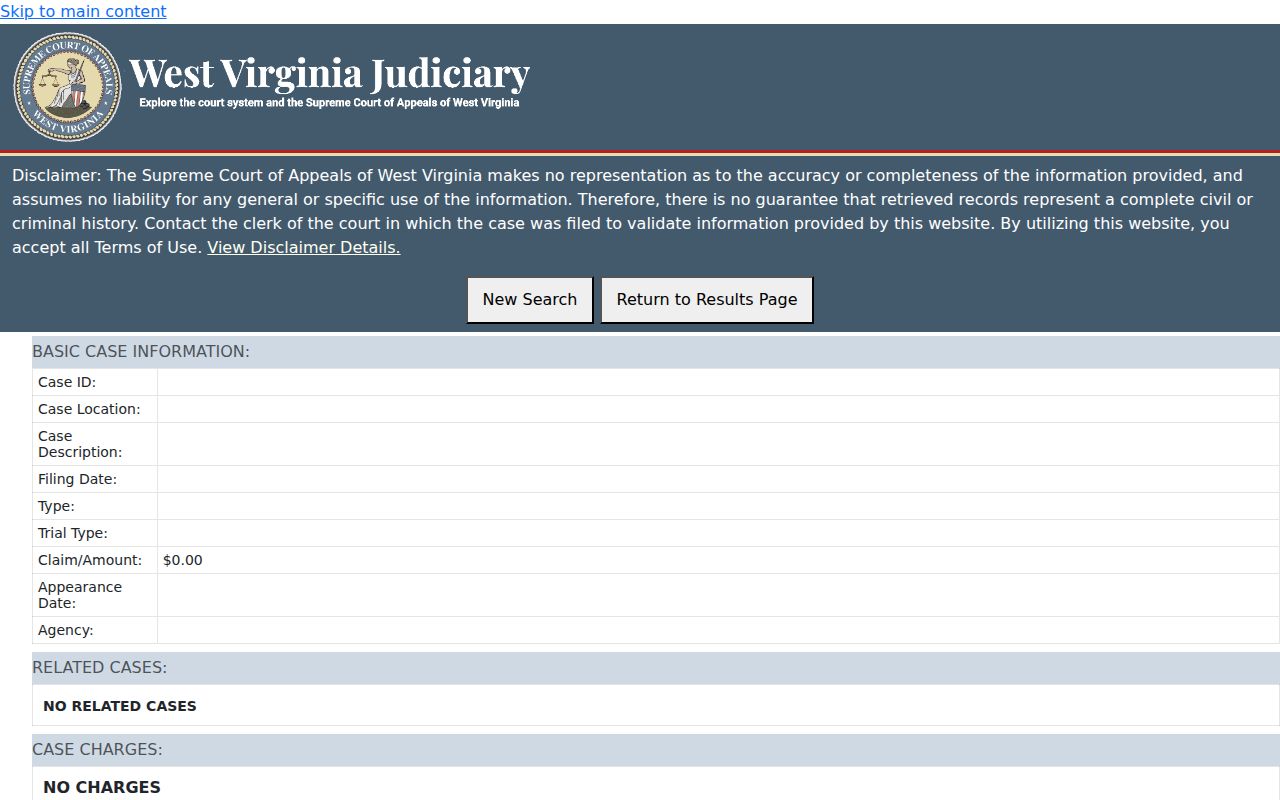
The layout makes one point clear: read the current event schedule and the chronological register together.
Clay County Setting Terms
West Virginia case records mix plain event names with short entry codes. A term may name a hearing, a request, or an event's status. It does not always describe the whole case.
- Preliminary hearing
- A magistrate review of probable cause in a felony matter before possible transfer to circuit court.
- Notice of hearing
- A docket item that announces a date, time, and often the place for a hearing.
- Continuance
- A request or order that postpones a setting. A motion alone does not create the replacement date.
- Reset
- A later setting that replaces the earlier one after the court acts.
- Hearing or event closed
- A status for the scheduled event. It does not necessarily mean the case is closed or sealed.
Other settings may cover an initial appearance, arraignment, motion hearing, trial, sentencing, judgment, review, or compliance event. Treatment, payment, probation, and deferred matters can all bring follow-up settings. No universal Clay County label covers every one.
Continuances, Resets, and Cancellations
A motion to continue is only a request. It does not set a new date by itself. In the magistrate docket, a MGMCT entry shows that someone asked for a continuance, while a later MGHCC entry marks a hearing or event closed. Neither entry proves a replacement setting on its own. The real proof is a later MGNCH notice of hearing or a newer row on the Event Schedule.
Read the sequence in order: old setting, motion or request, closed or reset notation, then a new notice with a date. Never stop at the first past date. The public interface gives no single Clay County reset label and no fixed window for changes to appear. When no later date is visible, call the clerk and ask whether the court has ruled on the motion.
A cancellation can also stem from dismissal, transfer, disposition, or some other court order. “Reason Closed” describes the event row alone. It does not prove the case was sealed. A court order or the clerk can settle that distinction.
Clay County Date Confirmation
The safest Clay County court date check draws on three things: the newest served notice, the latest portal event, and the clerk’s confirmation. Each one covers what the others miss. The notice carries formal instructions, and the portal reflects the most recent public record. For a room, a location, a late update, or a paper-only entry, the clerk is the one who can clarify.
| Source | Best use | Limit |
|---|---|---|
| Notice or order | Formal date, time, place, and attendance terms | May have been changed by a later order |
| MCRS or WVPASS | Newest public event or docket entry | May omit restricted, new, or paper material |
| Court clerk | Current confirmation and record-copy route | Requires the correct court and enough case detail |
The court posts no Clay-specific standing video link, holiday docket notice, or weather-closure calendar. State rules do permit video proceedings in some settings. A generic rule, however, never grants remote attendance in a particular case. Ask the clerk or the court office.
If You Miss a Court Setting
Act fast. Pull the case number and the latest notice. Check the newest public docket event, then call the clerk of the court that issued the setting. Contact counsel as well if a lawyer represents you. Ask what the docket now shows and what process the court requires. Paying online, leaving a message, or leaning on an old closed-event row does not resolve a missed appearance.
Missed a setting? A missed criminal or traffic appearance can lead to a failure-to-appear entry or warrant under applicable procedure.
Contact the correct Clay County clerk or your attorney at once and follow the court’s instruction for addressing the missed date.
Only the court can state whether a new appearance, motion, payment, or other response is required in the case.
Two offices split the record-keeping here. The magistrate clerk holds Clay County Magistrate Court records. The circuit clerk, though, keeps circuit records and public family docket material. Municipal, federal, probate, and county-commission cases sit elsewhere, often with the County Clerk. Search the wrong system and see nothing at all, even though a docket exists.
Clay County Public-Terminal Option
West Virginia puts public terminals in magistrate clerk offices statewide. Confirm Clay availability and hours before a trip. The Clay Magistrate Court Clerk is at 262 Main Street, Judicial Annex. A terminal helps when home internet access fails. It also helps when captcha screens are hard to manage, or when a public event needs to be viewed at the clerk's office.
Bring the exact case number if you can. MCRS accepts a party name. But it returns no more than 30 records, and common names can produce uncertain matches. Check that the case location reads Magistrate Court of Clay County, West Virginia. Need a document image? Ask the clerk. MCRS shows a document list, not the images themselves.
A written request should describe an existing record with reasonable detail. West Virginia Code section 29B-1-3 sets out a response route for specific public-record requests. Trial Court Rule 10.04 directs court-record requests to the court or clerk that keeps the record.